When I was in high school I played capoeira, a Brazilian martial art that blends dance, acrobatics, and combat. One day at training, I felt weaker than usual. Movements were harder, and I needed to sit down between plays. Something was off. I went to my doctor and he prescribed a blood test. The answer was simple: my iron level was incredibly low. Something that I learned later is that it's actually pretty common among women. I took iron supplements for a couple of months and quickly felt the results. My energy was back.
Since then, I've done regular blood tests to keep an eye on my iron levels. They became an opportunity for my doctor to check for other deficiencies too. That's how I found out I also lacked vitamin D.
I saved every one of those blood tests in a Health folder on my laptop, and gradually took on the habit of doing the same for everything health-related: prescriptions, MRIs, specialist letters, invoices.
In 2019, when I started as a freelance developer, my health coverage got worse. A new layer was added to my tracking: cost. I created a simple spreadsheet to log all my health expenses, plus a system to check what my freelancer insurance actually covered. Spoiler: it wasn't much.
My "Health" folder grew over the years, but I wasn't really doing anything with it. It just served as a reference when I needed to look something up.
While I've always been thoughtful about my health, as I've gotten older, I've become much more intentional about it. I've started paying more attention to the preventive side of things, instead of just showing up to the doctor when something feels off.
In 2025, I booked an appointment for a comprehensive health screening: 90+ biomarkers, not just the usual suspects. I discovered a couple of other areas where I was out of range, and appreciated finally having the full picture.
That same year, I discovered AI coding agents and I've been consistently blown away by how much you can achieve with them. I use it in my daily work for absolutely every task. I use it personally too, for daily habit tracking or fun one-offs like Will You Be My Valentine.
Last week, I caught one of those mega colds making the rounds: the kind that knocks you flat, plugs your ears, and makes you sleep like you haven't slept in ten years. Lying on the couch staring at the ceiling, I started thinking about my health again.
That's when it clicked.
I have years of data sitting in a folder on my laptop. I have AI tools. Why not build my own health dashboard? The data existed. I'd been saving it for years. I just couldn't visualize it in a practical way. But now, instead of a single snapshot with three biomarkers, I could have the full picture and year-over-year trends.
I gave an AI coding agent the folder and described what I wanted: the evolution of all my biomarkers over time, doctor prescriptions with what was prescribed, diagnosed conditions, health costs. I ended with: "Ask me any questions you need before we start."
The agent switched into planning mode right away and did exactly that: it asked me a series of clarifying questions to make sure it had the full picture before writing the first line of code. Should the dashboard be just for me locally, or hosted somewhere with a login? (Just for me.) Should it track all biomarkers or only specific ones? (All of them.) Was dosage and duration important to keep for prescriptions? (Yes. I could always remove it later if it felt like too much.)
Once I had answered each question, the agent got to work. It wrote Python scripts that used the Claude API to read each PDF, extract the structured data, and output it into JSON files: one for biomarkers, one for prescriptions, one for conditions, one for doctor visits and costs.
For example, here is a node from the biomarkers.json file:
{
  "name": "",
  "category": "",
  "value": "",
  "unit": "",
  "ref_min": "",
  "ref_max": "",
  "is_abnormal": ""
}
And one from the prescriptions.json file:
{
  "date": "",
  "doctor": "",
  "specialty": "",
  "reason": "",
  "medications": [
    {
      "name": "",
      "dosage": "",
      "duration": "",
      "purpose": ""
    }
  ]
}
Then the agent built a static HTML dashboard that reads those JSON files directly and runs locally on my laptop.
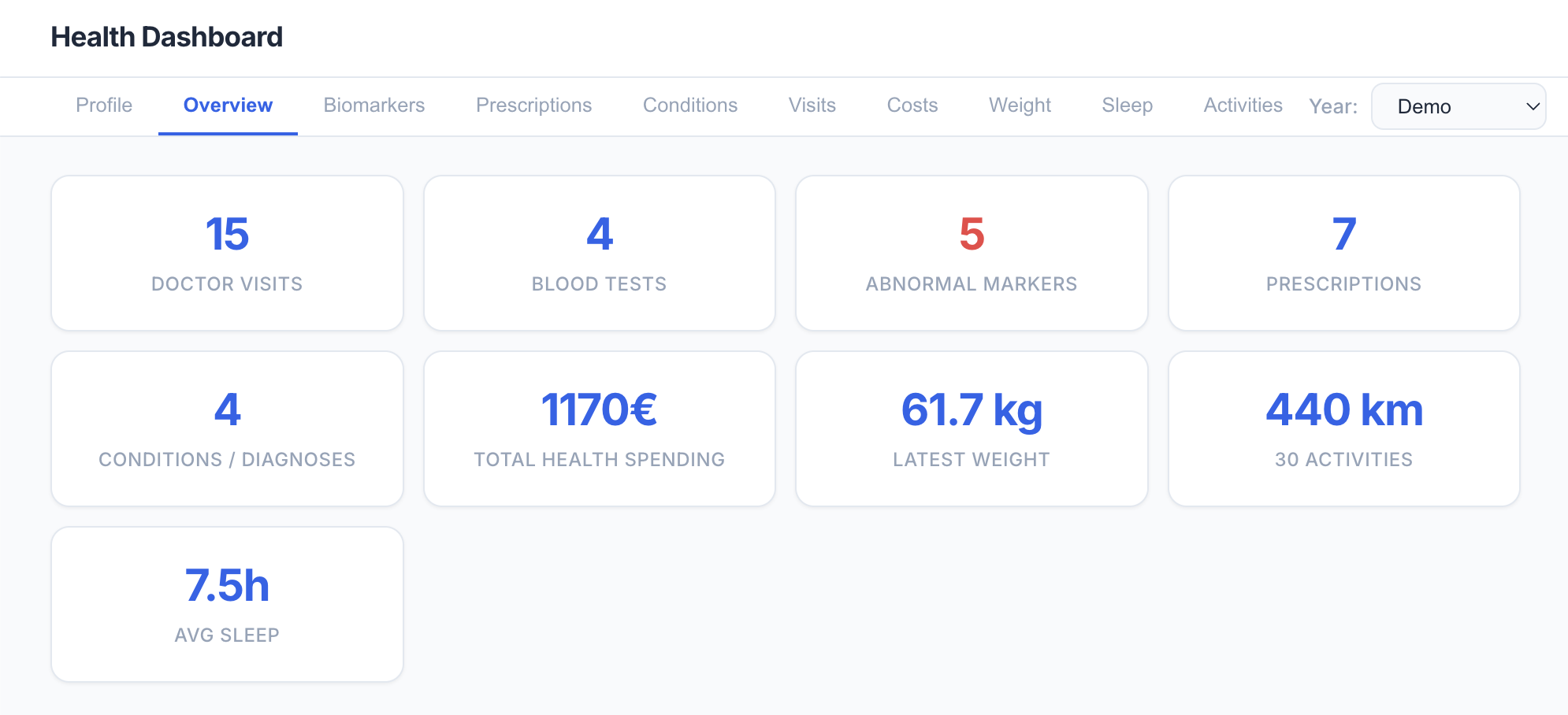
Less than an hour later, it was done. And it was exactly what I had in mind. I had several tabs available for me to browse my data: Biomarkers, Prescriptions, Conditions, Visits, and Costs; as well as the ability to filter per year. The only changes I had to make were styling tweaks, as I had given very basic styling guidelines initially.
Truthfully, "data visualization" sounds like a dry corporate expression. But when the data is yours, when it's your body and years of your own health history, seeing it rendered in charts for the first time feels different. I sat there and looked at it for a while, quite amazed.
Then I thought: can I make it even more comprehensive?
In January 2025, I bought a Garmin Forerunner 55. I had started running in 2024, and was looking for a device to track my training properly and prepare for races. I was so satisfied with my Garmin watch and the app that comes with it that I also started using it to track my sleep, weight, and overall activity.
Having my Garmin data in the same place as my health data felt like a natural next step.
To integrate the data, my first instinct was to check whether Garmin had an API. It turns out they do, but the form to apply to their Developer Program is so long that I immediately gave up (at least, for now). I wish they had a visible-at-all-time API key in my settings. It would have made it so much easier. Instead, I requested to export all my data. The page said it could take up to 30 days but fortunately I received it within the next hour. I fed all of it to the agent.
The dashboard got a lot more interesting.
In addition to my existing tabs, I now had Weight, Sleep, and Activities.
Finally, I added a Profile tab (with key information such as name, date of birth, height, latest weight, surgeries, job, work type, non-smoker, non-drinker) and an Overview tab for a global view before diving into specifics.
When looking at the dashboard, what I find genuinely useful isn't any single data point. It's the longitudinal view. I see my biomarkers levels and how they evolve over the years. I also see how my sleep holds up across seasons, and what I actually spend on healthcare by specialty. So many questions get answered by this simple view.
I'm sharing this because I imagine a lot of people have the same scattered data and have never thought to do anything with it. If you already have your health documents saved somewhere, you're only a few prompts away from having something like this built in an evening. A few years ago, you needed to be a developer to pull this off, and even then it would have taken days. That's no longer true.
Now, I know not everyone will want to give their health data to AI. I spent a lot of time considering this and determined that this was right for me. But consider this: an AI tool took years of my health data and created the most comprehensive view I've ever seen. If it could do that for me, what might AI be able to simplify for you?